There is an ideology embedded in American land management policy that its proponents rarely state explicitly — because stated explicitly, it would not survive the democratic scrutiny that its regulatory implementation has managed to avoid. The ideology is this: human presence on the land is, by definition, degradation. Man is the variable to be minimized. Wilderness is defined in federal law as land "untrammeled by man, where man himself is a visitor who does not remain." The minimization criteria require that trails be located to minimize human impact across every resource category simultaneously. The 30x30 framework measures success by the percentage of land from which human activity has been excluded.
The logic is consistent. The premise is contestable. And the premise is never debated — because the regulation, the litigation, and the international framework have made it structurally unnecessary to debate. The outcome arrives without the argument ever being made in public.
Tymmber Outdoor holds the opposite view. Not as a political position but as a foundational conviction: a better person makes a better world. Human beings, educated and invested in the terrain around them, are not the degrading variable in a healthy ecosystem. They are its most effective steward. The outdoor user who has run the same route for twenty years knows that landscape better than any satellite survey. The Tymmber Outdoor RoadSchool family camping in dispersed BLM land notices the invasive species, the eroded bank, the dry spring. The hunter, the angler, the overlander — these are not threats to habitat. They are its unpaid, passionate, perpetually present monitoring network.
One ideology holds that less human presence means more habitat health. The other holds that the right human presence — educated, invested, and sovereign — is habitat health's best defense. Only one of those ideologies has produced a measurable outcome. And neither side has been required to prove which one.
That is the question we should be asking. Not "how do we stop the trail closures?" but "show us the evidence that closing trails improved the habitat condition cited as justification." Just one peer-reviewed study. One before-and-after measurement. One tortoise population count that improved after 2,200 miles of routes closed. The regulation does not require it. The litigation does not produce it. The framework does not measure it.
We are not anti-conservation. We are pro-evidence. And the evidence for the ideology embedded in the minimization criteria — that human minimization equals habitat health — does not exist in the WEMO record. What exists is a regulation, a lawsuit, and a closure. What does not exist is a thriving desert tortoise population that can be attributed to any of them.
In April 2026, the Blue Ribbon Coalition filed a deep legal analysis of the regulation that actually closed the Western Mojave. Not the desert tortoise. Not land mismanagement. A single line of regulatory text — 43 C.F.R. § 8342.1 — called the minimization criteria. Read it carefully, because this is how an ideology becomes federal policy without congressional authorization:
Read that again. It does not say reduce impacts. It does not say mitigate impacts. It says minimize — across soil, watershed, vegetation, air, wildlife, cultural resources, and user conflicts, simultaneously. There is no threshold. No numeric target. No definition of when minimization has been achieved. No requirement to demonstrate that minimization produced any measurable habitat improvement. It is a standard that demands an endpoint it never defines — and never has to, because the endpoint is not the point. The process is the point. The closure is the product.
The court agreed that BLM met the standard Congress actually wrote — the Federal Land Policy and Management Act of 1976. BLM prevented unnecessary and undue degradation. Congress's standard was satisfied. The trails were closed anyway, because BLM could not satisfy a separate standard that BLM's own administrators wrote — one that goes further than Congress authorized, measures process rather than outcomes, and can never be demonstrated as complete.
BLM met the standard Congress wrote. The trails closed because of a standard the agency wrote for itself — with no defined endpoint, no required outcome measurement, and no evidence that closure improves the habitat condition it claims to protect. When a regulation measures process instead of results, it is not a conservation tool. It is an access elimination tool wearing conservation's language.
The policy debate around public land access has never honestly named its ideological divide. It speaks in the language of science — species recovery, habitat connectivity, biodiversity metrics — while the actual disagreement is philosophical. Here it is stated plainly:
Neither ideology has been required to prove its premise with outcome data. One has been embedded in federal regulation and international frameworks without that proof. The other has been litigated into silence without being given the opportunity to demonstrate its results. It is time to ask which one is right — with evidence, not process compliance.
In The Scholastic Trap, the argument is that institutions build standards designed to produce dependency rather than capability — standards that perpetuate authority by ensuring compliance can never be finalized. The minimization criteria are that architecture applied to land. The standard is not designed to produce thriving habitat. It is designed to produce perpetual process — and perpetual process produces perpetual litigation, and perpetual litigation produces perpetual closure.
The Rockefeller General Education Board's 1906 Occasional Letter No. 1 described an educational architecture in which "the people yield themselves with perfect docility to our molding hands." The minimization criteria produce the same docility in land management — the public yields its access to a standard it cannot define, administered by an authority it did not elect, producing outcomes it was never asked to approve and that are never required to be measured.
The Blue Ribbon Coalition makes the national threat explicit: 43 C.F.R. § 8342.1 applies to every inch of BLM-managed land in America. Every travel management plan in every state must satisfy the minimization criteria. Every plan is vulnerable to the same challenge. The anti-access playbook is simple — file suit arguing BLM didn't sufficiently demonstrate how routes were "located to minimize" impacts. The regulation provides no compliance threshold, so the agency can never prove it did enough. The court reopens the plan. More routes close. Repeat.
This is not speculation. It is the documented pattern. And it will not stop at California's border.
A regulation that demands minimization without defining what minimization looks like is not a management tool. It is a blank check for litigation — drawn on an account funded by your access to public land.
When you ask why nobody has fixed this — why a regulation written by unelected bureaucrats that exceeds what Congress authorized has been allowed to close trails, suppress access, and enable perpetual litigation for decades — the honest answer is that until June 28, 2024, the legal system was designed to prevent that question from being asked in court.
That mechanism was called Chevron deference. It came from a 1984 Supreme Court ruling and it operated like this: whenever a federal agency's regulation was challenged in court, judges were required to defer to the agency's own interpretation of the law — as long as that interpretation was "reasonable." It did not matter if the agency had exceeded what Congress actually wrote. It did not matter if the regulation went further than the statute authorized. As long as the agency's reading was plausible, the court had to accept it.
Think about what that meant for the minimization criteria. BLM wrote 43 C.F.R. § 8342.1 for itself — beyond the FLPMA statute Congress passed. When that regulation was challenged, courts didn't ask "did Congress authorize this?" They asked "is BLM's interpretation of its own regulation reasonable?" The agency was essentially the judge of its own authority. For forty years, that is how the administrative state worked. Agencies wrote their own rules, interpreted their own rules, and courts rubber-stamped both.
Chevron deference didn't just protect bad regulations. It made them immune. An agency could write a standard beyond congressional authority, interpret it to mean whatever served the outcome it wanted, and no court could override it. The fox was not just guarding the henhouse. The fox was also the judge at the hearing about the missing hens.
Then Loper Bright happened.
In June 2024, the Supreme Court overturned Chevron entirely in Loper Bright Enterprises v. Raimondo — a case that began not with trail closures but with fishing boats. A family-owned New Jersey herring fishing company was being forced to pay for federal monitors aboard their vessels under a National Marine Fisheries Service rule. The problem: Congress never said fishermen had to pay for those monitors. The agency wrote that requirement into regulation themselves, and under Chevron, courts had to accept it as reasonable.
The Supreme Court said no. In a 6-2 decision, Chief Justice Roberts wrote that Chevron had proved "fundamentally misguided" — that resolving whether an agency has acted within its statutory authority is the job of courts, not agencies. Courts must now exercise independent judgment. Agencies can inform that judgment with their expertise, but they can no longer bind it. The presumption that agencies can interpret their own authority however they choose — as long as it's "reasonable" — is gone.
For the minimization criteria, this is the crowbar BRC is now using. Their legal argument is a direct Loper Bright argument: Congress passed FLPMA requiring BLM to prevent "unnecessary and undue degradation." BLM then wrote its own separate regulation — the minimization criteria — that goes beyond that statutory mandate, demands compliance with a standard Congress never authorized, and has no defined endpoint. Under the old Chevron world, courts deferred to BLM's interpretation. Under Loper Bright, courts must now independently ask: did Congress actually authorize this? The answer, BRC argues, is no.
So why hasn't Loper Bright already fixed it?
Because the Supreme Court grandfathered every prior decision made under Chevron. Forty years of courts deferring to BLM's interpretation of the minimization criteria don't automatically disappear. Every case that was decided under Chevron — including prior WEMO rulings — remains standing. Loper Bright changed the rules going forward. It did not rewind the past.
What it did do is give BRC a legitimate legal argument in the current appeal and intervention — one that didn't exist before June 2024. They can now argue that the court must independently evaluate whether the minimization criteria exceed congressional authority, rather than simply deferring to BLM. That is a new argument with teeth. Whether those teeth are sharp enough to reverse 2,200 miles of closures is what is being decided in federal court right now.
Loper Bright was the ruling designed to address exactly this problem. It took 40 years to get there. BRC is now using it. The question is whether the courts — and the political pressure behind them — will let it work.
Fuller's principle applies here: you never change things by fighting the existing reality. You build a new model that makes the existing model obsolete. The new model begins with better questions — the ones the existing framework has been architecturally designed to never have to answer.
Question 1: Where is the outcome data? The minimization criteria have been used to challenge travel management plans across the American West for decades. Show us the peer-reviewed study demonstrating that closing OHV access improved the specific habitat condition cited as justification. Not a process compliance report. Not a litigation settlement. A measurable before-and-after comparison of the habitat outcome the closure was meant to produce. One study. We will wait.
Question 2: What does success look like? If 30% of American land is protected by 2030, by what measurable standard will we determine whether that protection worked? What species population counts will be taken at baseline and at endpoint? What water table measurements? What invasive species coverage maps? What biodiversity indices? If the framework cannot define what a successful outcome looks like, it is not a conservation program. It is a land exclusion program wearing conservation's language.
Question 3: Why are solar farms different? The same Mojave Desert where 2,200 miles of OHV trails were closed to protect desert tortoise habitat has approved multiple utility-scale solar farms that bury thousands of acres of that same habitat under panels, access roads, and transmission lines. The Ivanpah Solar Energy Generating System — built by BrightSource Energy LLC in partnership with NRG Energy and Google in the northeastern Mojave — was initially estimated to affect 38 desert tortoises. By the time the first phase of construction alone was complete, 49 had already been displaced, and the Bureau of Land Management revised its total estimate to as many as 140 adult tortoises displaced or killed, with hundreds of additional juveniles impacted. The Aratina Solar Center, developed by Avantus on 2,300 acres in Boron, California, was approved by Kern County despite documented tortoise presence and a 50% decline in California tortoise populations over the prior twenty years. The Rough Hat Clark County Solar Project, proposed by Spain-based Candela Renewables on 2,400 acres of Mojave public land near Las Vegas, was sited in habitat supporting an estimated 114 adult desert tortoises — in an area where tortoise density had already declined 67% between 2004 and 2014. More than 18,000 acres of Mojave desert tortoise habitat have been replaced by utility-scale solar development across the region. Same tortoise. Same desert. Same Bureau of Land Management. Different regulatory outcome. We are not claiming a conclusion. We are asking the question the framework has never been required to answer: what is the variable that changed between a closed OHV trail and an approved solar farm on the same tortoise's territory?
Question 4: Who monitors the land when the people leave? This is the question the access restriction framework never answers — because answering it honestly would undermine the premise that human exclusion equals habitat protection. When dispersed access closes and the outdoor user community is removed from the landscape, who takes their place as the habitat monitoring network?
The answer, documented in peer-reviewed conservation science, is: no one with comparable frequency, coverage, or local knowledge. Published research in Landscape Ecology (2025) identifies recreational visitors — hikers, outdoor recreationists, field users — as an undertapped but scientifically validated source of habitat monitoring data, specifically capable of detecting invasive species presence, habitat degradation, and unusual wildlife behavior that formal agency surveys miss between scheduled visits. A separate peer-reviewed study in PMC documents that citizen science participants — particularly those with specific recreational interests in a landscape — generate detection data across spatial extents and time periods that no agency monitoring budget can replicate. The Washington Trails Association's active community science program demonstrates that trail users systematically contribute species detection, habitat condition data, and invasive plant documentation that directly informs land management decisions.
The OHV rider who has run the same Mojave route for twenty years is not a threat to the desert tortoise. That rider is a twenty-year longitudinal observation record. They know where the water collects after rain. They know which washes have changed. They notice when the invasive grass appears. They are the early warning system that no satellite pass and no annual agency survey can replicate — because they are there every weekend, in every season, across decades.
When the Travel Management Plan closes and the rider leaves, that observation record leaves with them. The land does not become more monitored. It becomes less monitored — by exactly the people most invested in its health. Tymmber Outdoor RoadSchool and the broader HTU framework are built on this documented reality: educated, invested human presence on the land is not the problem the minimization criteria assume it to be. It is the monitoring infrastructure that the conservation establishment has been systematically eliminating while claiming to protect the habitat that infrastructure was watching over.
We are not asking these questions to win an argument. We are asking them because the answers would tell us whether the ideology embedded in the minimization criteria is producing the outcomes it claims to pursue. If it is — show us. If it isn't — the question becomes why a framework that doesn't produce its claimed outcomes continues to be the basis for closing public land to the public that owns it.

Buckminster Fuller — architect, systems theorist, and one of the fifteen minds honored in the Tymmber Outdoor Sages — built his principle here: you never change things by fighting the existing reality. You build a new model that makes the existing model obsolete. The dome made the argument that Fuller's words alone could not. Tymmber Outdoor is building the same kind of argument — in hardware, in content, in community, and in the field.
Habitat and Terrain Unification is the proposition that human presence on the land, properly educated and properly invested, does not degrade habitat. It monitors it, defends it, enriches it, and reports when something goes wrong. The outdoor user is not the problem variable. The outdoor user is the stewardship infrastructure that no federal budget has ever had to fund — because it showed up voluntarily, every weekend, for generations, before the Travel Management Plan told it to leave.


The images above are not marketing. They are the argument made physical. A TRAILPOD deployed on a desert riverbank — solar powered, content-capable, education-ready — with a family learning the landscape they are standing in. Two creators documenting the Sonoran at golden hour — cameras on tripods, solar trailer behind them, producing the record of what the land looks like today so it can be compared to what it looks like tomorrow.
These people are not degrading the habitat. They are becoming its most informed advocates. The child who learns the name of the tortoise, the location of the spring, the look of an invasive grass species — that child grows up to be the voter, the witness, the steward, and the citizen who will not quietly accept a closure notice that arrived without an outcome measurement attached to it.
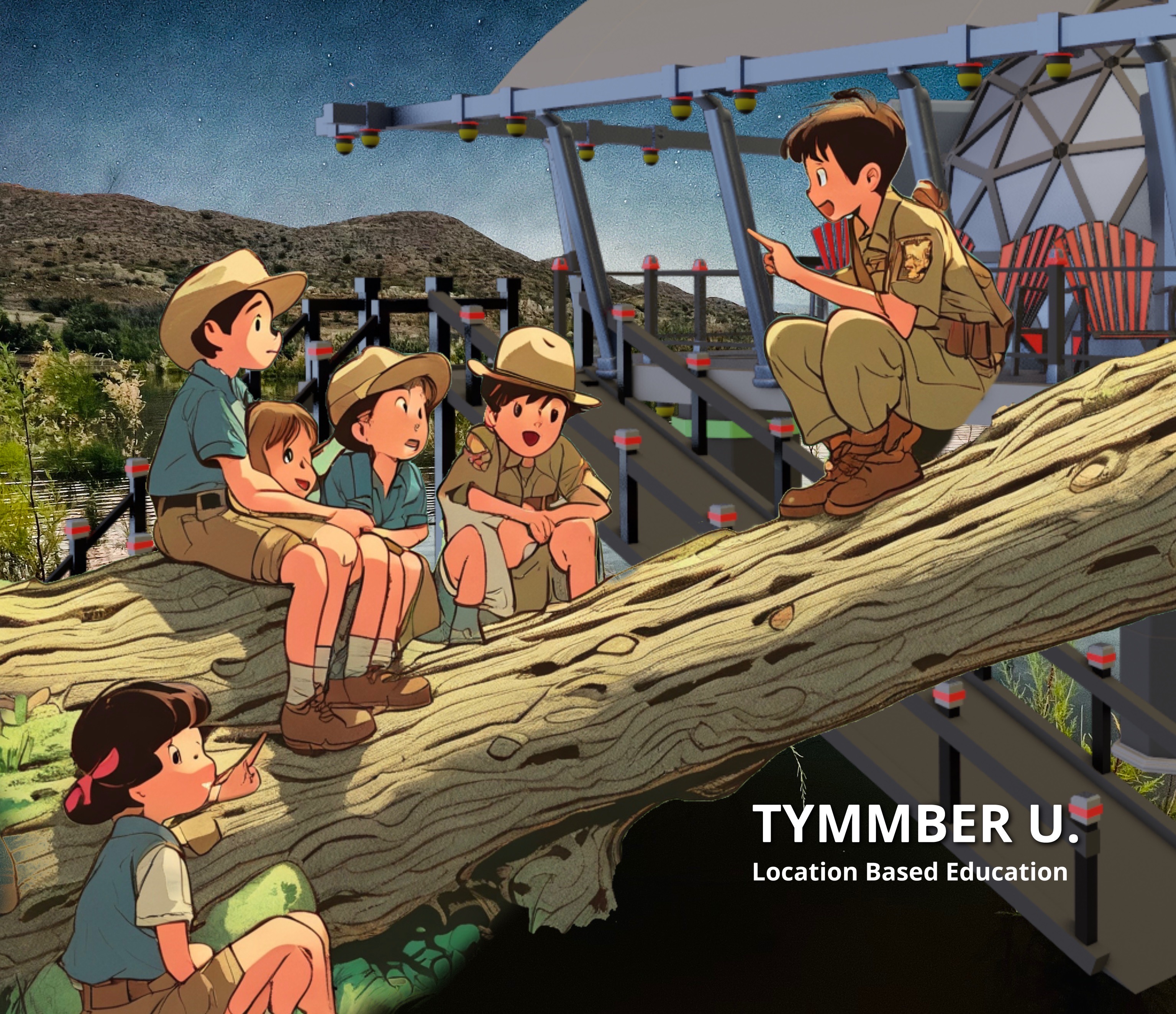
This is how you prevail against an ideology that holds a low view of man. Not by fighting it in court — though the court fight matters and BRC is doing it well. You prevail by building the evidence that the high view of man is correct. You put educated, invested, sovereign human beings on the land and you measure what happens. You document the habitat. You count the species. You map the water. You publish the data. And you build a generation of young people who know the land they stand on well enough to defend it with evidence rather than litigation.
Less is not more. Right is Might. The better argument wins — when it is made with data, demonstrated with outcomes, and delivered by a community large enough to be heard.
BRC's legal position is clear and correct: rescind the minimization criteria. The regulation exceeds congressional authority, has no achievable compliance endpoint, weaponizes litigation against every travel plan in the country, and — critically — has never been required to demonstrate that it produces the habitat improvement it claims to pursue. Loper Bright is the legal mechanism. The WEMO appeal is the test. Support BRC.
But the legal fight alone does not win the ideological argument. The ideology embedded in the minimization criteria — the low view of man — will survive any single court ruling because it is not housed in a regulation. It is housed in a worldview that has been institutionalized across federal agencies, conservation organizations, international frameworks, and academic conservation biology programs for fifty years. You do not defeat a worldview with a court decision. You make it obsolete with a better one.
The better worldview requires a demonstration. Habitat and Terrain Unification is that demonstration — built in hardware, documented in field observation, taught through location-based education, and measured in the outcomes the minimization criteria have never been required to produce. Tymmber Outdoor is building the platform. Tymmber Outdoor RoadSchool is building the curriculum. The Sovereign Circle is building the community. And TymmberU is building the course that teaches every member how to read the landscape, understand the ideology operating on it, counter it with data, and build toward the outcome both sides claim to want: thriving habitat on public land that belongs to all Americans.
That is the stand. That is the mission. That is the argument the existing framework cannot absorb — because it agrees with the stated goal of conservation while dismantling the operational model that has never been required to demonstrate it is achieving that goal.
Right is Might. Less is not more. A better person makes a better world — and a better landscape.
A broken regulation and a litigation strategy that exploits it are two pieces of the picture. The third piece is who was running the agency while all of this unfolded — and where they came from.
In 2021, President Biden appointed Nada Wolff Culver as Deputy Director of the Bureau of Land Management — the agency's second-in-command, first in the line of succession. Before joining BLM, Culver had spent nearly 16 years at The Wilderness Society as Senior Counsel and Director of their BLM Action Center. In that role she helped develop the legal strategies used to challenge BLM travel management plans — including the original WEMO litigation. She was, in the language of the courtroom, a plaintiff's attorney working against the agency she would later be appointed to run.
The case that followed her appointment is documented in federal court records under the title Center for Biological Diversity v. Culver. The same organizations she had worked alongside for 16 years — Center for Biological Diversity, Sierra Club, and others — filed the successor WEMO lawsuit. Nada Culver was named as the federal defendant. The attorney who had sued BLM was now being sued as BLM.
She went from helping bring the original WEMO lawsuit on behalf of advocacy organizations to serving as the named federal defendant in the successor WEMO case — as the second-in-command of the agency she had spent 16 years suing. That is not a metaphor for institutional capture. It is a documented legal caption.
The final act came on January 17, 2025 — three days before the administration change. Culver, serving as Acting BLM Director, signed a Policy Memorandum titled "Application of the minimization criteria at 43 C.F.R. § 8342.1." The memo instructs every BLM State office on how to interpret and apply the exact regulation at the center of the WEMO closure. It applies to every travel management plan on every acre of BLM land in the country. It is, in practical terms, the codification of a 20-year outside litigation strategy into binding national agency policy — signed on the way out the door.
When BLM Director Tracy Stone-Manning departed federal service, she became President of The Wilderness Society — the same organization where the previous Acting Director had spent 16 years before joining BLM. The Acting Director then served eleven days before the administration changed, and has since returned to The Wilderness Society as its President. The strategy was built outside the agency. It was brought inside the agency. It was codified as binding national policy on the last available day. And the people who executed it returned to the organizations where the strategy originated.
This pattern is not unique to the Bureau of Land Management. It is not unique to conservation policy. It is the documented operating model of the modern administrative state — and it is how ideology persists across administrations, survives electoral changes, and becomes embedded in regulation regardless of who wins any particular election.
The same carousel operates at the Environmental Protection Agency, the Food and Drug Administration, the Securities and Exchange Commission, the Federal Communications Commission, and across the national security apparatus. Attorneys, scientists, and policy architects move from advocacy organizations and industry into agency leadership, write or implement the regulations that serve the worldview they brought with them, and return to the private or nonprofit sector — often to the very organizations whose objectives their regulatory tenure advanced. This is not conspiracy. It is institutional physics. People carry their beliefs with them. Institutions are shaped by the beliefs of the people who run them. And the people who seek agency leadership positions are disproportionately those with the strongest prior commitment to a particular policy outcome.
The result is what you observe across American regulatory history: policy continuity that outlasts any administration, regulatory frameworks that embed ideological premises as technical standards, and career civil servants who provide the institutional memory that ensures the direction holds even when the political appointees change. In The Scholastic Trap, this is the mechanism by which expert dependency perpetuates itself — not through any single actor's intention, but through the structural logic of institutions selecting for the people most committed to their foundational assumptions. The WEMO timeline is one documented example of that mechanism. It is not the only one. It is the one we can trace precisely, with names, dates, and a policy memorandum signed on January 17th.
Intellectual honesty requires applying the same scrutiny to the administration that followed. President Trump nominated Kathleen Sgamma — president of the Western Energy Alliance, an association of independent oil and natural gas companies with interests on public lands — to lead the Bureau of Land Management. Like her predecessor, Sgamma came to her nomination with extensive litigation experience against the agency she was nominated to run. The Western Energy Alliance, under her leadership, had filed lawsuits against BLM challenging restrictions on oil and gas drilling on public lands. The legal caption on the Biden side was a conservation organization suing BLM. The legal caption on the Trump side was an energy industry organization suing BLM. Same revolving door. Different direction. Identical mechanism.
The outcomes speak in the same structural language. The Trump administration opened 13.1 million acres of federal land to coal leasing, approved more oil and gas drilling permits in 2025 than any year in the prior fifteen, and rescinded the 2001 Roadless Rule that for twenty-five years had protected nearly 60 million acres of national forest from road-building and commercial logging. More than 21.3 million acres of BLM-managed lands are now under active lease for oil and gas development — and taxpayers are projected to lose approximately $6 billion in royalty revenue over the next decade as extraction rates were rolled back to their 1920 levels.
One administration closes the land to the public in service of a conservation ideology. The next opens it to extraction in service of an energy industry. In both cases the public — the actual owner of the land — is the variable that gets managed rather than served. The paddle changes hands every four years. The public never gets to serve.
This is not a partisan observation. It is a structural one. And it leads to a hypothesis worth stating plainly: the two ideologies — conservation exclusion and energy extraction — are not opposites. They are two versions of the same low view of man. One says the land is too valuable to let ordinary people use. The other says the land is too valuable not to extract. In both frameworks, the dispersed public interest — the family camping on BLM land, the OHV rider who knows every wash in the Mojave, the RoadSchool student learning the terrain — is subordinated to a concentrated interest that arrived with the appointment pen and will depart with it.
What neither framework produces is a third outcome: land that is healthy, accessible, and sovereign — belonging to the people who own it, monitored by the people who use it, and managed by a standard that measures habitat outcomes rather than process compliance or extraction volume. That is the outcome Habitat and Terrain Unification is built to demonstrate. It is the outcome that neither concentrated interest has an incentive to produce. And it is the only outcome that serves the 268 million Americans the Despair Economy has already taught to believe that the systems built in their name were never actually built for them.
In The Scholastic Trap, the argument is that institutions are captured not through conspiracy but through the patient placement of like-minded people into positions of authority — people who have spent careers developing a worldview, a legal strategy, and a set of organizational relationships, and who then apply all three from inside the institution rather than against it. The WEMO timeline is that argument documented in court filings, appointment records, and a policy memorandum signed three days before a presidential transition.
This is not a failure of the system. This is the system working exactly as it was designed to work — by the people who designed it, from the inside, while no one was required to ask whether the public's interest in their public land was being served.
The map you may have seen in the 1990s — showing vast swaths of American land designated as wilderness cores, buffer zones, and human-free corridors — was called the Wildlands Project. It proposed setting aside 50% of North America for non-human use, with human settlement concentrated in designated areas. At the time it circulated, it was widely dismissed as fringe environmental advocacy. The U.S. Senate, presented with the UN Biodiversity Treaty that undergirded it in 1994, declined to ratify it.
That map did not go away. It went institutional.
In December 2022, 190 countries adopted the Kunming-Montreal Global Biodiversity Framework — the UN's most ambitious conservation commitment in history. Its centerpiece target, known globally as 30x30, calls for 30% of the world's terrestrial land, inland waters, and coastal areas to be designated as protected areas by 2030. The framework calls explicitly for "ecological connectivity" — the unimpeded movement of species across landscapes — and identifies motorized human activity and habitat fragmentation as primary threats to that connectivity.
President Biden signed an Executive Order committing the United States to the 30x30 goal in his first week in office in 2021. President Trump overturned that commitment in his first weeks in office in 2025 — a decision that went largely unreported amid everything else happening simultaneously, but which had immediate international implications.
The Wildlands Project was rejected by the U.S. Senate in 1994. Thirty years later it returned as official UN policy, signed by 190 nations, funded with $5 billion in international conservation capital, and embedded in executive orders. The map did not change. The mechanism did.
This matters for WEMO because the minimization criteria — the regulation that closed 2,200 miles of trails — produces 30x30 outcomes without requiring 30x30 to be formally implemented. Every mile of closed OHV route becomes de facto protected area. Every travel plan invalidated by litigation reduces the human footprint on the landscape. The legal strategy does not need a treaty. It needs a regulation with no defined endpoint and organizations with permanent litigation budgets. Both exist.
There are interests beyond the borders of the United States that have a significant stake in the WEMO ruling standing — and in the minimization criteria remaining intact as a replicable tool. International conservation organizations, multilateral biodiversity frameworks, and foreign governments that have committed to 30x30 targets all benefit when American domestic litigation produces the land access restrictions that a ratified treaty would require. A precedent set in the Mojave Desert is a precedent that applies to every BLM travel plan in every western state — and a model that can be replicated in every signatory nation.
We are not claiming coordination. We are noting alignment. When outcomes match objectives, the mechanism of production is a secondary question. The question that matters for every American who recreates on public land is simpler: who decided that the highest and best use of your public land is land from which you are excluded? Congress did not decide that. The American people did not vote on it. A regulation written by unelected administrators, exploited by well-funded litigation organizations, and aligned with international frameworks the U.S. Senate declined to ratify — that is what decided it.
In Memo 002, we introduced Tymmber Outdoor RoadSchool — a location-based education program built on the conviction that the outdoors is not just a recreational amenity but an irreplaceable classroom. Children learning to read a landscape. Families navigating terrain together. Knowledge that cannot be transmitted through a screen or a curriculum because it requires presence — physical, embodied presence in a place.
Tymmber Outdoor RoadSchool is not incidentally threatened by the WEMO ruling and the 30x30 framework. It is specifically threatened by them. The 30x30 framework identifies human activity — including recreation, motorized access, and what it calls "habitat fragmentation" — as incompatible with its conservation goals. The logical endpoint of that framework, applied through litigation tools like the minimization criteria, is a public land system that humans can observe from designated viewpoints and access on permitted trails — but cannot live in, work from, drive through, or teach their children in the way that Americans have done for generations.
Tymmber Outdoor RoadSchool is the declaration that this endpoint is unacceptable. Not because conservation is wrong — but because conservation that excludes human beings from the land is not conservation. It is dispossession dressed in scientific language. The child who learns geography by driving through it, ecology by camping in it, geology by climbing on it — that child becomes a steward of that land in a way that no protected area designation ever produces. You protect what you know. You know what you have access to.
The argument for keeping public land public is not anti-environment. It is pro-human. And a nation that forgets the difference between those two things will eventually find itself negotiating for permission to visit the land its tax dollars purchased.
— Mike Isaacs
Founder, Tymmber Outdoor
Sierra County, New Mexico · Nullius in Verba