What an Outdoor Recreation
Cabinet Is Actually For.
Memo 017 made the case for the seat. This is the case for what sits in it.
A Cabinet-level Outdoor Recreation department has one job that matters more than any other: turn the outdoors from something New Mexico sells access to into something New Mexico builds. Trails matter. Parks matter. But most of the $3.6 billion outdoor recreation economy this Cabinet would oversee walks in built somewhere else — manufactured overseas, shipped here, sold here, and shipped right back out as profit to companies that have never touched New Mexico soil.
This charter is the mission that changes that math. Four pillars, one workforce pipeline underneath all of them: a liaison embedded in every peer cabinet, a six-zone manufacturing map built from capacity New Mexico already has, a reshoring case built on the same numbers every outdoor brand in the country is already reading, and a carbon-free electrification strategy that turns New Mexico's grid into a selling point instead of an afterthought.
From the Case for the Seat
to the Case for the Work.
Memo 017 argued that a $3.6 billion, 31,000-job sector shouldn't operate through someone else's Cabinet seat. That argument stands on its own. This document assumes it succeeds — and answers the question a Governor or a Legislature asks next: fine, you get the seat. What do you do with it?
The current Outdoor Recreation Division manages access — trails, grants, permitting, coordination with land managers. That work continues under Cabinet status; nothing here replaces it. What changes is the addition of a second mission sitting next to it, equal in weight: economic development. Not tourism marketing. Not visitor counts. The actual industrial base — manufacturing, supply chain, jobs, and the workforce pipeline that feeds all three.
Built on Six Years, Not From Zero
This charter proposes a lot that's new. None of it erases what already exists. The Division ORD was created in 2019 has six years of real execution behind it, and the Cabinet inherits that record — it doesn't start one.
That record is the argument for trusting this department with more, not a reason to assume it needs to be rebuilt. Every section that follows is an addition to a working foundation.
The ROI Standard
Trail and parks spending isn't a soft-benefit line item — it's measurable, and the measurements are good. A 2026 Ohio statewide study found every public dollar invested in parks and outdoor recreation generates approximately $3 in economic value. An ASU-led study of Maricopa County, Arizona found $4.85 returned per dollar of parks operating spend. New York's newest Empire State Trail report found $5.43 in sales revenue generated per dollar invested. The Sierra County State Recreation Area (SRA) — a separate Tymmber proposal for a hybrid public-private outdoor recreation development district, detailed in full in its own document — projects a roughly 6:1 return on its own Phase 1 trail investment of $7.5 million against $45 million in projected annual return, consistent with the high end of that documented range.
The standard this Cabinet should hold itself to: every dollar spent on trails and programs is expected to return $3 to $6 in measurable economic activity, tracked and reported the same way the SRA's own financial projections are — not asserted once and never checked again. That's a real, sourced range. It doesn't need to be inflated past what the evidence supports to make the case; the case is already strong at $3 to $6.
Not every dollar gets there equally, and pretending otherwise is how a department ends up with a portfolio of mediocre trails instead of a few that work. The studies above differ for real reasons, not just regional luck: how many people live within reach of the investment, whether the spending it draws is new money from outside the area or just displaced local spending, whether visitors can stay overnight or are capped at a day trip, whether the money completes an already-popular network or sits isolated, and whether there's anywhere nearby for visitor spending to actually land. Equal spend on two trail segments with different scores on those five factors should not be expected to produce equal returns — and shouldn't be funded as if they will.
The ROI Potential Score
Before this Cabinet funds a trail or park initiative, it scores the candidate against five factors — not as a formality, as the actual basis for which projects get capital first.
| Factor | What It Measures | Why It Drives Return |
|---|---|---|
| Drive-Time Population | How many people live within a reasonable drive of the investment | More people in reach means more potential users at the same construction cost |
| Destination Ratio | Share of likely users traveling from outside the area vs. already living nearby | Imported visitor spending is new money in the local economy; spending by people who already live there is mostly displaced from somewhere else in town |
| Overnight Capacity | Whether lodging exists or is planned nearby | Overnight visitors spend several times what day-trip visitors spend — a trail without nearby lodging caps its own ceiling regardless of trail quality |
| Network Completion Value | Whether the investment finishes or extends an already-popular trail or park network, or stands alone | Completing a missing link in a known network unlocks that network's existing audience; an isolated segment starts from zero |
| Complementary Infrastructure | Whether restaurants, retail, and services exist nearby to capture visitor spending once it shows up | Visitor spending without anywhere to land either leaks out of the local economy or never materializes |
Score every candidate, fund the high scores first. The Sierra County SRA scores well on all five — six-metro drive-time access, a destination built around a lake and a trail system rather than local utility use, planned overnight Solar Hut and lodging capacity, direct alignment with the Río Grande Trail's existing network and audience, and an existing hospitality base in Truth or Consequences to capture the spending. That's the actual reason its own 6:1 projection is credible, not just optimism. A 10x return is the right bar to screen candidates against internally — fund the projects that could plausibly clear it, and let the ones that can't wait their turn or get redesigned to score better. It is not a number this charter should publish as a guarantee; the $3–$6 range above is what's actually been measured, and that's what goes in front of a legislator.
Energy and Minerals manages what New Mexico has. Outdoor Recreation builds what New Mexico is becoming. A department that only manages access has half a mission. This charter is the other half.
A Liaison in Every Cabinet.
Not a Committee. A Job.
No state has built this yet. The closest comparable is Vermont's Outdoor Recreation Collaborative, established by executive order in 2017 — it advises the Department of Forests, Parks and Recreation and the Agency of Commerce and Community Development. That's a real precedent for cross-agency coordination. It is also an advisory body, not an embedded staff position with a budget line and a deliverable. New Mexico would be the first state to build the second version.
The model is simple: every peer Cabinet that touches the outdoor recreation economy gets one dedicated person whose job is translating that Cabinet's mission into outdoor recreation economic development — with a defined deliverable, not just a standing meeting. A liaison without a budget line and a measurable output is a meeting invite, not a job. That's the failure mode this design has to avoid.
This is the first explicitly novel piece of this charter. There's no other state's playbook to point to. That's the point — New Mexico didn't wait for the Confluence of States before creating the Division in 2019, and it doesn't need to wait for another state to prove the liaison model before building it here.
Appointment status: every liaison is appointed directly by the OR Cabinet Secretary, serves at the Secretary's pleasure, and is not a permanent civil-service position. When a new Secretary takes office, every liaison is re-interviewed or replaced. This is the same standard New Mexico already applies to Cabinet secretaries themselves — EMNRD's secretary, for example, is appointed by the Governor to serve at the Governor's pleasure, with no tenure protection. This charter extends that logic one level down.
That's the right call, for the reason it's being proposed: a liaison network is only useful if it reflects the current administration's actual priorities. A liaison who can't be replaced is a liaison who eventually stops representing anyone but themselves — exactly the permanent, unaccountable layer this charter is trying to avoid building. The honest tradeoff is continuity. A Public Education liaison spends two years building the relationships that get outdoor career pathways embedded in CTE funding, then a new administration resets the position to zero. The fix isn't tenure — it's a requirement, written into the liaison job description itself, that every departing liaison leaves a working transition record for whoever replaces them: what's been negotiated, who the actual relationships are with, and what's mid-process. The job resets. The institutional memory doesn't have to.
Six Zones. New Mexico Already
Has the Capacity. It's Scattered.
Every zone below is built on capacity, infrastructure, or workforce that already exists in that region — this is a redirection map, not a build-from-zero wish list. Some zones ask New Mexico to point existing technical talent at a new category of product. Others ask the state to retrain an existing skilled workforce whose original industry is, by New Mexico's own numbers, on a declining trajectory.
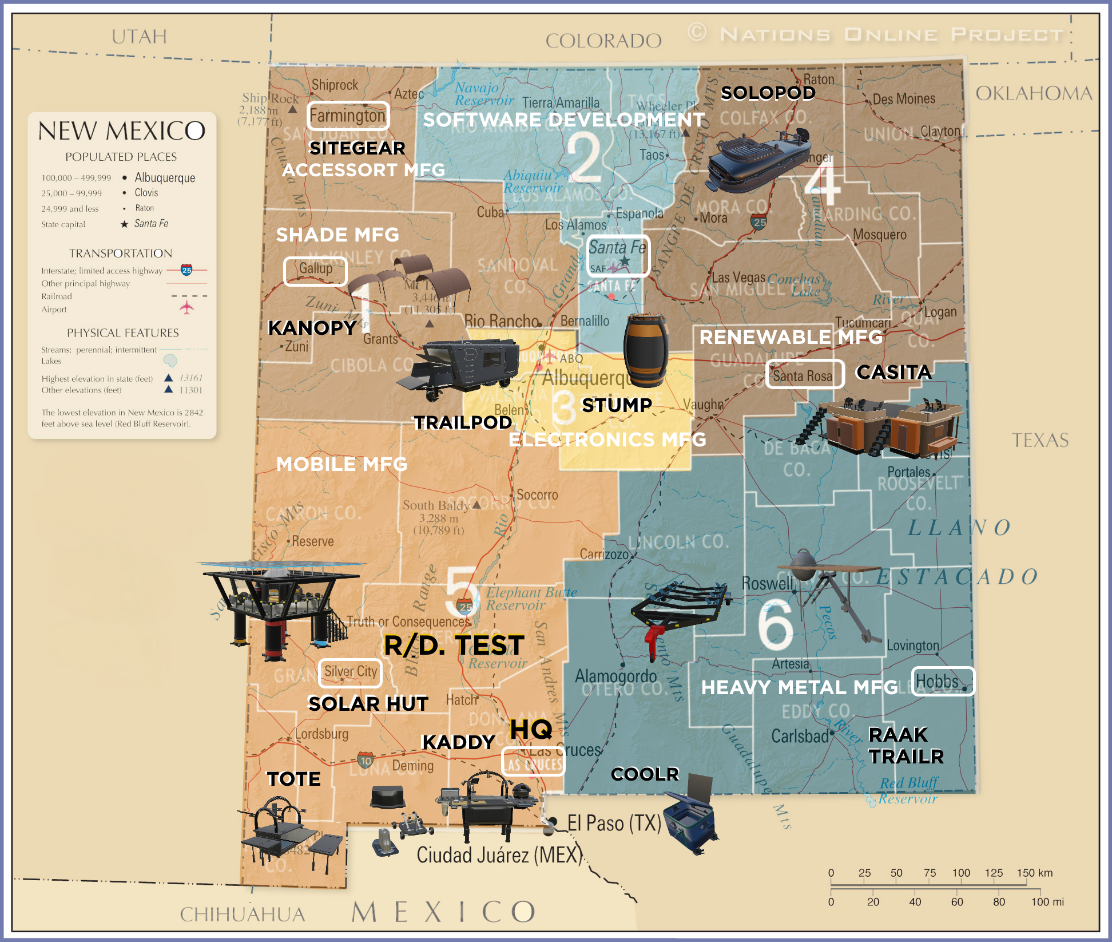
| Zone | Region | Sector Focus | Why This Zone |
|---|---|---|---|
| 1 | Northwest Gallup · Farmington · Zuni |
Shade structures, soft goods, accessory manufacturing | Existing rural manufacturing base and a regional textile and fabrication workforce already in place. |
| 2 | North Taos · Los Alamos · Santa Fe · Española |
Software and embedded electronics development | Los Alamos and Sandia National Laboratories plus Santa Fe's design economy already concentrate this exact technical talent pool. |
| 3 | Central Albuquerque · Rio Rancho · Belen |
Electronics and control systems manufacturing | Rio Rancho's existing semiconductor fab presence and Sandia's electronics supply chain mean this zone redirects capacity rather than building it from zero. |
| 4 | Northeast Raton · Las Vegas, NM · Mora · Clayton |
Renewable-input and battery component manufacturing | Sits inside New Mexico's strongest wind corridor with transmission infrastructure already running through it. |
| 5 | Southwest Las Cruces · Truth or Consequences · Silver City · Deming |
Mobile and modular product manufacturing, R&D testing | NMSU engineering, Spaceport America, and White Sands already cluster aerospace and mobility R&D talent in this corridor. |
| 6 | Southeast Roswell · Artesia · Carlsbad · Hobbs · Lovington |
Heavy metal fabrication and welding | The Permian Basin's oil and gas fabrication workforce is the same skill set heavy-metal outdoor product manufacturing needs. This is workforce redirection in the exact region Memo 017 already names as overdependent on a declining revenue source. |
Zone 6 is worth pausing on. Memo 017's entire economic argument rests on New Mexico's 35–41% General Fund dependence on oil and gas revenue the state itself expects to decline. A skilled welder in Hobbs doesn't need a different skill set to build a utility trailer than to build oilfield equipment — they need a different customer. That's the same diversification argument 017 makes about state revenue, applied to a single worker's career.
Where Outdoor Recreation Could Stand
More Than Half of What We Sell
Comes From Somewhere Else.
China accounts for an estimated 54.8% of all outdoor recreation industry imports. The U.S. is on pace to import 55% of its athletic and sporting goods this year — $11.4 billion worth — with China again the dominant source. That's the offshoring baseline this Cabinet's economic development mission is built to push against.
The trend is already moving. Outdoor sector manufacturers have widely adopted a "China Plus One" strategy — diversifying assembly footprints beyond a single country to cut tariff exposure and supply chain risk. Academy Sports and Outdoors cut its Chinese production exposure from 50% in 2024 to 6% by the end of 2025. One year. One company. That's not a multi-decade industrial policy bet — it's a sourcing decision a company made because the math changed.
Here's the honest gap. Texas, South Carolina, and Mississippi are the named top states for 2025 reshoring and FDI activity — New Mexico isn't on that list yet. This charter doesn't pretend otherwise. It's the reason the rest of this document exists: the six zones are the answer to where, the liaison network is the answer to how, and the workforce pipeline in Section 06 is the answer to who builds it. Nationally, 88% of 2024 reshoring jobs landed in high or medium-high tech sectors — which is exactly the lane New Mexico's national-lab-adjacent talent pool in Zones 2 and 3 is built for.
The Next Wave of Outdoor Gear
Plugs In.
Off-road vehicles, trailers, watercraft, and snowmobiles are electrifying the same way passenger cars did a decade ago. No state has positioned itself as the place that builds the electrified version of outdoor gear. New Mexico's grid already makes a stronger case for that position than almost any state actively competing for this industry.
New Mexico's 2025 electricity generation mix was 36.2% wind, 26.8% natural gas, 20.8% coal, and 15.5% solar — combined renewables already above 52%, ahead of the state's own Renewable Portfolio Standard target of 50% by 2030. The standard requires 100% zero-carbon generation by 2045. New Mexico is decarbonizing its grid faster than its own law requires it to. That's a stronger pitch to an EV-adjacent manufacturer than raw solar capacity — where New Mexico ranks 18th nationally despite having some of the best solar insolation in the country. The honest claim isn't "most installed capacity." It's "ahead of mandate, with the sun to go further."
This connects directly to the Carbon Free Resort concept already in development as a Tymmber moonshot, and to the EV charging corridor along I-25 already identified as a Sierra County SRA emerging market. The manufacturing categories this Cabinet should court — without naming specific companies, since that list changes faster than any charter should claim certainty about it — span:
- Off-road EV mobility — electrified ATVs, UTVs, and snowmobiles
- EV trailers and towables
- Electric marine and watercraft propulsion
- EV battery and stationary power systems — both mobile and off-grid
- Connected vehicle software and telematics
- Prefab and modular carbon-zero structures — tiny homes, portable hospitality
- Residential and portable solar manufacturing
Each of these maps onto one or more of the six zones in Section 03. The Department of Transportation liaison in Section 02 builds the charging infrastructure these manufacturers need to sell into; the Energy, Minerals and Natural Resources liaison aligns the grid that powers their factories.
None of This Works Without
Workers. Start in Kindergarten.
Six manufacturing zones and a carbon-free strategy are demand-side. None of it lands without a supply of trained people, and a state can't import that workforce as easily as it can import a factory. The pipeline below begins with education and ends with execution — it's the same architecture Tymmber has already prototyped through TymmberU, OREE, and Road School, formalized here as the literal job description of the Public Education and Workforce Solutions liaisons in Section 02.
Begins with education. Ends with execution.
State Parks Comes Home.
Here's What Doesn't Move.
Three structural decisions, applied with one consistent test: does the mission actually belong in this Cabinet, or does it just touch outdoor recreation at the edges? Two existing agencies move in. One new division gets built from scratch. Five agencies stay exactly where they are.
New Mexico's 35-park State Parks Division and the Río Grande Trail Commission both sit inside the Energy, Minerals and Natural Resources Department today — not because the mission fits, but because that's where they landed before the Outdoor Recreation Division existed to house them. A Cabinet built around outdoor recreation without the actual park system, or the body that governs the state's flagship trail, isn't complete. Both move. The Commission is a state-legislatively-empowered body that sets trail alignment, approves Gateway Community designations, and oversees policy for the 500-mile Río Grande Trail — the same Commission the Sierra County State Recreation Area (SRA) proposal already engages directly. It has no energy or minerals function. It belongs with the department that will be funding and developing new trail segments under Section 09.
This is a mission-fit question, not a turf dispute. Departments get reorganized when a program's actual function stops matching the department holding it — that's ordinary administrative housekeeping. Memo 017 already frames the two Cabinets as peers: "Energy and Minerals manages what New Mexico has, Outdoor Recreation builds what New Mexico is becoming." Moving these two divisions is that distinction applied consistently.
A third decision belongs alongside the first two, and it isn't a move — it's a new division. State Recreation Areas shouldn't be filed under State Parks as more park inventory, because the two run on different models. State Parks is a conservation-and-access system: fee-supported stewardship of land already protected. The SRA model is a public-private development district — concessions, events, EV mobility infrastructure, lodging partnerships, the active commercial development Section 13 of the SRA proposal plans to repeat 4–6 times across the state. Folding the second into the first slows both down: State Parks' stewardship mandate gets pulled toward deal-making it wasn't built for, and the SRA model inherits an operating culture built for conservation, not development speed. A separate State Recreation Areas Division, sitting beside State Parks inside the same Cabinet, gives each its own mandate and its own pace.
| Division / Agency | Current Home | Recommendation | Why |
|---|---|---|---|
| State Parks Division | EMNRD | Move to OR Cabinet | The literal recreation asset. Belongs with the department whose mission is recreation economic development, not energy and minerals. |
| Río Grande Trail Commission | EMNRD | Move to OR Cabinet | A trails-policy body with no energy or minerals function. Belongs with the department that will also be funding and developing new trail segments under Section 09. |
| State Recreation Areas Division | N/A — doesn't exist yet | Create, separate from State Parks | A different operating model from State Parks — public-private development and revenue generation, not primarily conservation and access. Separate mandate, separate pace, same Cabinet. |
| Forestry Division | EMNRD | Stays — liaison only | Fire suppression on 43 million non-federal acres and watershed health is a distinct, life-safety mission. Trail and recreation coordination already runs through the EMNRD liaison in Section 02. |
| Dept. of Wildlife (Game & Fish) | Independent Cabinet agency, commission-governed | Stays independent — liaison only | Funded almost entirely by hunting and fishing license fees tied to federal Pittman-Robertson and Dingell-Johnson matching dollars restricted to wildlife management. Its commission governance was just reformed in 2025–26. Folding it in risks both the funding and the reform. |
| Tourism Department | Independent Cabinet department | Stays independent — liaison only | A genuine judgment call, not an obvious one. Tourism's mission is broader than outdoor recreation — cultural heritage, conventions, film. Worth revisiting if the two departments end up competing for the same visitor-economy budget. |
| State Land Office | Independently elected constitutional office | Cannot move — partnership only | Not a Cabinet department. The Commissioner of Public Lands is elected separately from the Governor under Article V of the state constitution. The current Commissioner has already stated interest in promoting outdoor recreation on trust lands — a partnership opportunity, not an org chart change. |
| Indian Affairs Department | Independent Cabinet department | Stays independent — liaison only | A government-to-government relationship with sovereign tribal nations. This is a coordination relationship by design — see Section 02 — never an absorption candidate. |
What This Means Going Forward
Every new state-level trail and park initiative going forward is housed in this Cabinet: new State Recreation Areas under the new SRA Division — a designated, hybrid public-private outdoor recreation district combining trail and water access with lodging, concessions, and event infrastructure, the model laid out in full in the Sierra County SRA proposal — new state trail segments under State Parks or the Río Grande Trail Commission, and any park acquisition funded by the Outdoor Trust Fund in Section 09. One department builds and owns the state's trail and park strategy, instead of the next initiative landing wherever it happens to land.
Two scope limits worth stating precisely, so this doesn't overclaim authority the state doesn't have. Federal land: trails on national forest, BLM, or other federal land stay under federal management — this Cabinet partners and co-funds through mechanisms like the Trails+ Grant, it doesn't own them. Local and municipal trails and parks: county and city park systems remain local government property — this Cabinet's role there is the same grant-funding and coordination role ORD's Trails+ Grant already plays today, not absorption. "Housed in this Cabinet" means every new initiative the state itself develops, funds, or designates. It doesn't mean every trail in New Mexico answers to one Santa Fe office.
Two divisions move because their mission already belongs here. One new division gets built from scratch, with its own mandate. Five agencies stay exactly where they are, because their mission doesn't fit this Cabinet any more than State Parks fit inside Energy and Minerals. Same test, applied the same way, every time.
New Mexico's First OR Cabinet
Secretary Isn't a Trails Person.
Most state outdoor recreation offices are led by people with conservation, tourism marketing, or land-management backgrounds — the right profile for an office that manages access. This charter argues for a Cabinet built around economic development first. That means the first Secretary needs a different profile than the role has historically attracted, and the state should say so directly rather than default to the familiar one.
- A vision and mission genuinely rooted in the outdoor experience. This is the actual test, not a checkbox alongside the others. Someone who can articulate why time outdoors changes people and communities, and means it — not someone managing a portfolio that happens to include trails.
- Real standing inside the outdoor industry — earned more than one way. That can be operating experience at a manufacturer, retailer, or outfitter. It can just as easily be a board seat or leadership role at an outdoor industry trade association, or deep program experience built inside the industry over years. The path matters less than whether the industry already knows and trusts this person.
- Economic development background. Site selection, incentive structuring, or business recruitment experience — someone who understands how a state actually wins or loses a relocation decision.
- A credible public communicator. This Secretary testifies in committee, recruits companies from a trade show stage, and does the press conference when a deal falls through, not just when one closes. That's a distinct skill from policy expertise.
Direct experience landing a manufacturing relocation is a strong plus, not a gate — useful if it's there, not disqualifying if it isn't. The non-negotiable is the first line: vision and mission rooted in the outdoor experience. Everything else is a credential that supports it.
A Mission Needs Its Own
Revenue, Not Just a Budget Line.
Right now, New Mexico's only dedicated outdoor-specific funding mechanism is the Outdoor Equity Fund — a grant program, recently moved to ORD's administration from the Youth Conservation Corps Commission, funded through the Land of Enchantment Legacy Fund. That's real progress, and it's not enough. Once State Parks moves into this Cabinet under Section 07, the Cabinet inherits 35 parks' worth of maintenance backlog and acquisition ambition that a grant program was never built to carry, plus a liaison network and a manufacturing-recruitment mission that need their own operating budget. One funding mechanism can't carry all of that. This charter proposes four, each matched to a different job.
Stream 1 — Parks: The New Mexico Outdoor Trust Fund
A dedicated sales tax on outdoor recreation equipment, channeled directly to parks and conservation funding, is a proven category of state law — not a New Mexico invention.
| State | Mechanism | Scale | Dedicated To |
|---|---|---|---|
| Texas | Sporting Goods Sales Tax — created 1993, fully and constitutionally dedicated by voter amendment in 2019 | ~$168.5M/year | Texas Parks and Wildlife Department and the Texas Historical Commission |
| Georgia | Outdoor Stewardship Act — 2018 | 75% of sales and use tax on outdoor recreation equipment | Land conservation, state park and wildlife management area stewardship |
| Missouri | Conservation Sales Tax — 1/8 of 1% statewide | $100M+/year since 2012 | Wildlife and habitat conservation |
| New Mexico (proposed) | New Mexico Outdoor Trust Fund — a gross receipts tax increment on outdoor recreation product sales, paired with an SRA revenue share below | Scales with the six-zone manufacturing build-out and the SRA network | State Parks maintenance and acquisition, plus the existing Outdoor Equity Fund |
The second piece of this stream is the SRA's own revenue. The Sierra County SRA proposal already projects $37–53 million in cumulative 10-year tax revenue, diversified across lodgers tax, gross receipts tax, property tax, event fees, permits, and concessions — and Section 13 of that proposal envisions 4–6 more SRAs across the state once Sierra County proves the model. None of that revenue is earmarked for parks today; it flows to the general fund like any other tax receipt. The proposal: dedicate a fixed share of the gross receipts and lodgers tax increment generated inside each SRA's boundaries — not statewide, just the SRA itself — to the Trust Fund above. Each SRA becomes a funding source for parks the same way it's already a destination, and the Trust Fund grows as the SRA network grows, without a new statewide tax vote required for each addition.
Stream 2 — Operations: The Spaceport Precedent
New Mexico doesn't need to pass a new version of the Trust Fund mechanism to know it works — it's already running one, in exactly the counties this charter cares most about. The Spaceport America Regional Spaceport District was created by the Legislature in 2005, funded by a ¼% gross receipts tax that voters in Doña Ana and Sierra counties approved by special referenda in 2007 and 2008. It raised $76.4 million toward the spaceport's roughly $220 million construction cost, with 75% of ongoing revenue pledged to bond repayment and 25% flowing to local spaceport-related education. Doña Ana County carries about 95% of that debt load, Sierra County about 5% — same rate, different tax base.
The political opening already exists without this charter having to create it. A sitting state senator has gone on record arguing the tax burden shouldn't fall on just two counties. A Doña Ana County commissioner who sits on the spaceport tax board has said publicly the money could have been better spent elsewhere in the county. There's documented criticism that the spaceport has used revenue beyond bond service for daily operations. This charter isn't introducing a fight about whether the spaceport tax should end — that conversation is already happening.
The honest constraint: the 75% pledged to bond repayment is contractually committed to bondholders and can't simply be redirected while bonds are outstanding — that's a binding pledge, not a budget line. Bonds were refinanced in 2021 at a sharply lower rate, with county officials citing 2029 as the expected payoff date at that time; this needs to be reconfirmed against the District's current bond schedule before it's cited publicly. The 25% education share isn't pledged to bondholders the same way and is the nearer-term target. The proposal: redirect the education share now, and target the full ¼% for OR Cabinet operating funding — liaison network costs, manufacturing zone recruitment, Secretary's office — at bond maturity. Framed as "this tax already did its job, here's what it builds next," not as walking away from a commitment.
Stream 3 — Industry Growth: The Outdoor Products Checkoff
Parks and Cabinet operations are public goods — broad-based taxes are the right tool. Marketing "Made in New Mexico" outdoor gear and recruiting the next manufacturer into the six zones is a private-sector growth function, and the industry that benefits from it should fund it directly. That's a checkoff: a mandatory per-unit assessment on producers, collected by an industry board, spent on collective marketing for the whole industry — the same mechanism that funded "Got Milk?" Dairy farmers pay roughly 15 cents per hundredweight of milk produced into the National Dairy Checkoff; the funds built one of the most recognized ad campaigns in American advertising history.
A state-level outdoor products checkoff has the same bootstrapping problem any new-industry funding mechanism has: it generates almost nothing until manufacturers actually relocate into the six zones. The fix is to attach it to the recruitment deal itself rather than pass it as a freestanding tax. New Mexico's existing Local Economic Development Act already uses project participation agreements with clawback provisions for companies taking state incentives. The checkoff assessment rides on that same paperwork — a company accepting a six-zone incentive package agrees to the assessment as a condition of the deal, no separate enabling statute required to get started.
One governance lesson worth building in from day one, not learning the hard way: the dairy checkoff has drawn real criticism for collecting over a billion dollars while thousands of dairy farmers went out of business in the same stretch, and for failing to file legally required spending reports for years. Whatever board administers New Mexico's version needs a binding annual public reporting requirement written into its founding statute, not assumed as a courtesy.
Stream 4 — The Sovereign Wealth Fund, Honestly
New Mexico's State Investment Council manages more than $68 billion across nine permanent funds — the third-largest sovereign wealth fund in the country. The headline number invites an obvious question: can any of that fund this Cabinet's mission? Mostly no, for one fund, and already-yes for another — and the difference matters.
The big one, the Land Grant Permanent Fund, holds roughly $32 billion of that total and is the wrong target. It exists under the federal Ferguson Act of 1898 and the 1910 Enabling Act, held in trust for 21 specifically named beneficiaries — 88% of it goes to public schools by formula. Redirecting any of it to a new beneficiary isn't a legislative vote; it's a constitutional amendment at minimum, against a trust New Mexico was once sued by the federal government over mismanaging. This charter isn't proposing that fight, and shouldn't.
The fund that actually fits already exists and is already funding this Cabinet's work today: the Conservation Legacy Permanent Fund, a $350 million trust the Legislature created in 2023 specifically for land, water, and outdoor recreation infrastructure, distributing through the Land of Enchantment Legacy Fund at roughly $12.5 million a year. The Outdoor Equity Fund and the Trails+ Grant — both already counted in Section 01's track record — are funded through this exact mechanism today. It passed both legislative chambers with bipartisan support, and the Legislature already committed to growing it with escalating annual appropriations after the initial investment. There's a proven precedent for asking the Legislature to grow it further.
The ask: explicit, earmarked growth in the annual Land of Enchantment Legacy Fund appropriation, directed at the two things this charter envisions and the existing fund's purpose already covers — State Recreation Area development under the new SRA Division in Section 07, and expanding the outdoor education pathway programs in Section 06's workforce pipeline through the Public Education liaison. Not a new fund. Not a fight over the Land Grant Permanent Fund's trust obligations. More money into a $350 million vehicle that's already proven it can pass and already proven it can deliver.
Four streams, four different payers, four different jobs: the public funds the parks it visits, a sunsetting tax funds the department that replaces what it was built for, the industry being recruited funds its own marketing, and a proven conservation trust fund grows to cover what it was already built to cover. None of them ask the general fund for new money, and none of them touch a trust New Mexico has no business reopening.
Five Deep Dives. This Is the Map.
This charter is the hub. Each pillar above earns its own standalone page once the data and design work behind it is ready. Below is where each one will attach.
What This Charter Builds On.
Two documents this charter assumes and extends. Read them first if you're new to the argument.
Nullius in Verba applies here as it does everywhere on this site — including to our own zone map and our own 2035 projection, both clearly marked as Tymmber's planning estimates, not government data.
Building This Mission?
This charter is a working draft. The next step is the five deep dives above, and a conversation with anyone — legislator, agency staff, or manufacturer — ready to help build the department this describes.